Organizing Musical Progress: The Role of Practice Assignment Notebooks
In the disciplined pursuit of musical mastery, consistent and structured practice is paramount. Whether for a student under a teacher's guidance, a self-directed learner, or a professional refining their craft, the act of practice transcends mere repetition. It requires planning, reflection, and tracking progress over time. This is where the specialized tool of a music practice assignment notebook becomes invaluable. Specifically designed for clarity and accountability, these notebooks provide a framework that transforms practice sessions from casual playing into focused, goal-oriented development.
The Core Functionality of a Practice Log
A music practice notebook serves as a central hub for a musician's daily work. At its most basic, it is a dedicated space to record assignments given by a teacher or set by oneself. This might include specific pieces to work on, technical exercises like scales or arpeggios, and broader conceptual goals such as dynamics or phrasing. Beyond simply listing tasks, its primary function is to log the actual practice completed: what was worked on, for how long, and what observations or challenges arose. This creates a tangible record of effort and improvement, combatting the common feeling that practice time is unproductive or unfocused.
From Paper to Digital Product: The KDP Model
The advent of platforms like Amazon's Kindle Direct Publishing (KDP) has democratized the creation and distribution of such specialized tools. A Music Practice Assignment Notebook designed for KDP is a digital interior file, meticulously formatted to meet the platform's technical specifications. It is a template, a ready-to-use structure that creators can publish as a physical paperback notebook. These products are often categorized as "low-content" or "no-content" books because the core value lies in the designed layout and functionality, not in authored text. The user—the musician—fills the content with their personal practice journey.
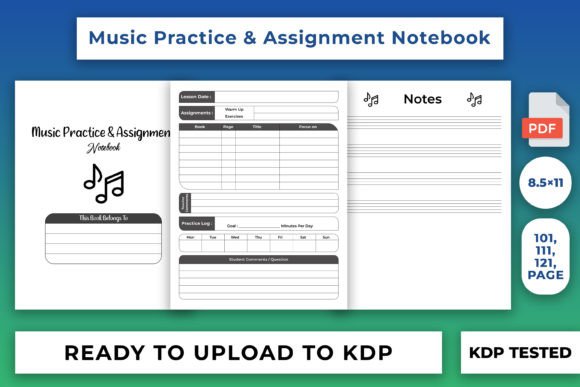
These KDP interiors are typically delivered as a tested PDF file, ensuring compatibility with KDP's upload system. Standard features include a trim size of 8.5 x 11 inches with no bleed, making it suitable for a standard workbook format. They often come in multiple page count variations, such as 101, 111, or 121 pages, providing options for different practice durations—a semester, a year, or a more intensive course. The inclusion of a simple intro page is common, offering a clean starting point. The design is pre-formatted, with sections for date, assignment details, practice notes, and checkboxes, all ready for printing and immediate use.
Key Characteristics and Design Advantages
A well-designed Music Practice Assignment Notebook KDP interior possesses several distinct characteristics that benefit both the end-user and the publisher.
- Structural Clarity: The layout guides the musician logically through their session. Defined areas for the assignment, the practice log, and teacher or self-evaluation notes prevent the journal from becoming a chaotic diary.
- Encourages Consistency: The simple act of opening the notebook and writing down a plan reinforces commitment. Seeing previous entries creates a chain of accountability, motivating the user to maintain their routine.
- Focus on Progress Tracking: Unlike a generic notebook, these specialized interiors prompt for specific details. Recording the time spent on a difficult passage or noting a breakthrough in tempo provides measurable data that charts growth, which is particularly encouraging for long-term development.
- Versatility Across Disciplines: While the label is "music," the application is broad. The structure is effective for piano, violin, voice, guitar, or any instrumental study. It can be adapted for academic music theory homework or even choreography rehearsal, demonstrating its flexible utility.
The Practical Benefits for Musicians and Educators
For the student, particularly younger learners, the notebook bridges the communication between lesson time and home practice. It carries the teacher's directives accurately, reducing ambiguity. The student learns to self-assess by writing notes on what felt easy or hard, developing critical listening and analytical skills essential for artistic growth. For the self-taught adult hobbyist, it imposes a needed structure, turning an enjoyable activity into a progressive skill-building endeavor with clear milestones.
For educators and teachers, these notebooks streamline pedagogy. They can quickly write or refer to assignments, review a student's logged practice to understand challenges outside the lesson, and use the notes to tailor subsequent instruction. It formalizes the practice expectation, making the student's responsibility clear. In ensemble settings, like school bands or choirs, a shared understanding of using such a log can elevate the entire group's preparation efficiency.
Considering the KDP Interior as a Business Asset
From a creator or business perspective, a formatted Music Practice Assignment Notebook interior represents a specific market opportunity. The demand for organizational tools in niche hobbies and education is steady. By offering a tested, high-resolution PDF, the product is essentially a digital asset that can be sold directly to consumers looking for a practice log or used by other KDP publishers as a base for their own branded notebook.
The "low-content" aspect means the investment is in design and formatting rather than extensive writing. Considerations here involve usability: the layout must be intuitive and comprehensive without being overwhelming. Page count options (101, 111, 121 pages) allow for targeting different customer preferences—some may want a notebook for a 3-month summer program, others for a full academic year. Ensuring the PDF is KDP tested is crucial; it eliminates technical barriers for the publisher, guaranteeing the interior meets margins, trim size, and resolution requirements for professional printing.
Real-World Applications and Use Cases
The application of these notebooks extends beyond the stereotypical image of a child with a violin. Consider a community choir member preparing for a seasonal concert. Using the notebook, they can jot down the conductor's notes on vowel shaping for a particular piece, log their 30 minutes of sight-reading the new score, and note that they need to work on the alto line in section B. The structured format makes this efficient.
Another example is the returning pianist. After years away from the instrument, they decide to relearn. By setting weekly assignments for themselves—mastering the first movement of a sonata, revisiting chord progressions—and logging daily practice in the notebook, they combat frustration with concrete evidence of slow, steady re-acquisition. The notebook becomes a personal curriculum.
For professional musicians, such a tool can manage the preparation for a recording session or recital. It allows for breaking down a complex program into daily technical and interpretive goals, ensuring every minute of limited practice time is strategically allocated. The observational notes section can capture ideas about phrasing or emotional expression that might otherwise be forgotten.
Observations on Implementation and Long-Term Value
Implementing the use of a music practice notebook requires a slight shift in mindset. It adds a brief administrative task to the practice routine—the writing itself. However, this is not a burden but a metacognitive exercise. The act of writing solidifies intent and promotes reflection. A common observation from users is that the notebook makes practice time feel more "official" and worthwhile, increasing both satisfaction and retention.
The long-term value is archival. A filled notebook from a year of study is a document of growth. It can reveal patterns: perhaps technical exercises are consistently logged as short sessions, indicating a potential area of avoidance. It shows the journey from struggling with a piece to marking it "mastered." This historical record is invaluable for teachers assessing a student's trajectory and for musicians themselves, providing a concrete answer to the question, "Have I improved?"
In the context of KDP and digital publishing, the availability of these ready-to-use interiors lowers the barrier for entrepreneurs to serve this niche. It allows educators, musicians, or simply organized individuals to create a physical product that supports artistic discipline. The product's success hinges on its design meeting real pedagogical and psychological needs—offering structure without rigidity, prompting useful reflection without demanding lengthy prose.
Ultimately, a Music Practice Assignment Notebook, whether a bespoke handmade journal or a published KDP paperback, is more than stationery. It is an instrument of accountability and a map of progress. It externalizes the internal, often nebulous, process of musical learning, giving it form, order, and a path forward. In a pursuit where progress can sometimes feel intangible, this tangible record of effort becomes a powerful motivator and a trusted companion in the lifelong journey of musical development.