Organizing Your T-Shirt Business: The Role of a Dedicated Order Log Book
For anyone running a small-scale t-shirt printing operation, managing orders is often where the real challenge lies. Between custom designs, sizes, color variations, and customer details, information can scatter across notes, digital messages, and memory. This is where a purpose-built tool like a T-shirt Order Form Log Book becomes a central consideration. It’s a physical ledger designed to systematically capture every detail of a t-shirt transaction, transforming a potentially chaotic process into a standardized routine.
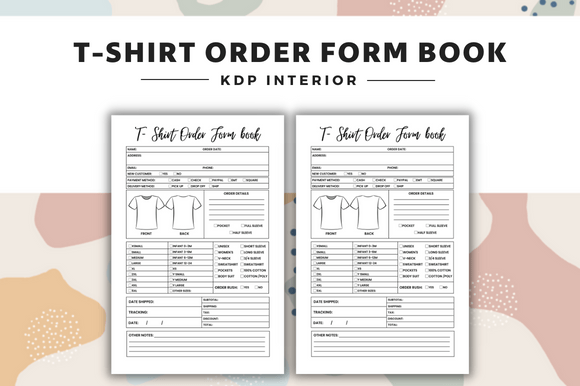
What distinguishes a dedicated log book from generic notebooks or digital spreadsheets is its specific structure. It pre-defines the fields you need: customer name, contact information, order date, design specifications, size breakdowns, color choices, payment status, and delivery notes. This predefined format eliminates the guesswork of what to record each time, ensuring consistency and completeness. For many, the act of writing it down physically also creates a tangible record that can be easier to reference quickly during busy production days.
Comparing Formats: Physical Logs Versus Digital Systems
When evaluating how to track orders, you’re essentially choosing between two broad categories: analog systems like the T-shirt Order Form Log Book and digital tools. Each approach carries distinct strengths and tradeoffs that fit different working styles and business scales.
A physical log book offers immediacy and simplicity. There’s no software to learn, no risk of data loss from technical glitches, and no distraction from notifications. It can be left open at a workshop station, accessible to multiple team members without needing login credentials. The limitation, however, is in scalability and analysis. Searching for a specific order from months ago requires manually scanning pages. Calculating total orders for a particular design or generating financial summaries involves manual tallying, which becomes impractical beyond a certain volume of orders.
Digital systems, like spreadsheets or specialized order management software, excel at searchability, calculation, and remote access. Data can be filtered, sorted, and analyzed instantly. However, they require a device, can be vulnerable to input errors if the template isn’t locked, and may feel less intuitive for hands-on creators who spend their day in a physical workspace. The decision often hinges on your order volume and your personal affinity for technology. For a craftsperson handling 5-10 custom orders per week, a well-designed T-shirt order Book might be perfectly efficient. For a larger operation with wholesale clients and complex inventory, digital tools likely become necessary.
Key Features and Practical Specifications
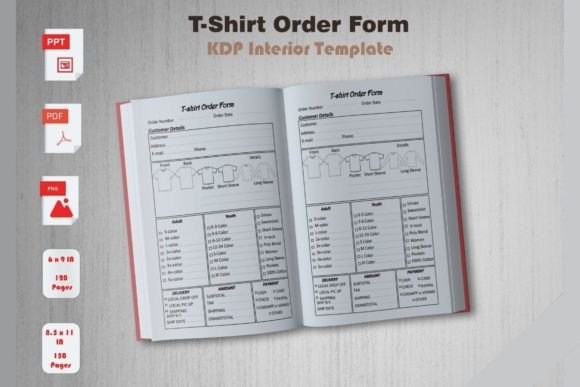
A professionally designed log book template, such as the ones described with 6x9 inch or 8.5x11 inch dimensions, aims to balance utility with practicality. The 6x9 inch format is often more portable, resembling a trade paperback, easy to store on a shelf or carry. The 8.5x11 inch version provides larger writing spaces, which can be beneficial if your orders involve lengthy design notes or multiple item lines.
The inclusion of source files for customization—like PowerPoint (PPTX)—is a significant feature for those comparing options. It means the template is not a static product. If your specific process requires a unique field, such as “Fabric Type” or “Pantone Color Code,” you can adapt the layout before printing. This flexibility bridges the gap between a completely generic notebook and a costly custom-printed ledger. Having a print-ready PDF alongside editable source files offers a path from standardized use to personalized optimization.
Understanding the Tradeoff of Pre-Structured Pages
The pre-structured nature of a T-shirt Order Form Log Book is its core advantage, but it also implies a commitment. You are adopting a single system for recording all orders. This works beautifully if your service offerings are relatively consistent. For example, if you primarily offer a set of predefined designs with standard sizing, the template will fit seamlessly.
However, if your business is highly experimental—where every order is a wildly different project involving non-apparel items or complex partnerships—the fixed fields might feel restrictive. In such cases, a more free-form journal or a digital database you can continuously reshape might be a better fit. The log book template is best seen as a framework for stability. It encourages discipline and thoroughness, which is invaluable for building a reputable, reliable brand, but may not suit the initial, chaotic exploration phase of a business.
Scenarios Where a T-Shirt Order Log Book is the Right Choice
Certain situations strongly align with the benefits of a physical order log. Consider a small boutique that runs weekend pop-up events. The ability to quickly jot down orders on a unified form in a busy, offline environment is crucial. Later, the owner can transfer the data digitally if needed, but the on-site capture is reliable and simple.
Another realistic example is a family-run custom printing setup serving local schools and sports teams. Orders often come in via phone or in-person meetings. Having a dedicated book next to the phone or on the workshop counter ensures details are recorded accurately at the moment of commitment, reducing miscommunication. The book also becomes a shared reference point for everyone involved in production and fulfillment, minimizing internal confusion.
Furthermore, for individuals who value the separation between creative work and administrative tasks, a log book provides a clear ritual. Completing a physical form for an order signals the transition from sales conversation to production queue. This psychological segmentation can improve focus and organization.
When You Might Need an Alternative Approach
It’s equally important to recognize when a T-shirt order Book, even a customizable one, might not be the optimal resource. If your business model is inherently online-first, where all orders originate through an e-commerce platform, a physical log becomes a duplicate system. Your primary record is already digital, and your need might be for integration tools that connect your store to your inventory and shipping software, not for a secondary handwritten ledger.
Similarly, if you are scaling rapidly and anticipate needing to delegate order management to multiple employees or remote teams, a cloud-based system that allows simultaneous, real-time access from different locations is almost mandatory. The physical book can become a bottleneck. Also, businesses with strong data analysis needs—like tracking seasonal trends, calculating precise profitability per design, or managing complex customer relationships—will require the computational power of digital tools.
Making an Informed Decision: Factors to Consider
Choosing between a physical log book, a digital system, or a hybrid approach involves weighing a few concrete factors. First, assess your order volume and complexity. Low volume with simple orders leans toward physical; high volume or complex orders leans toward digital. Second, consider your work environment. Is it predominantly hands-on in a studio or mostly online and remote? Third, think about your future growth plans. Are you aiming for a stable, manageable craft business, or planning aggressive expansion? A log book suits the former path well.
Finally, evaluate your own management style. Do you prefer tactile, simple tools that minimize screen time, or do you thrive on data and automated reminders? The goal is to select a system that reduces friction and error in your process, allowing you to focus more on design and quality. A well-designed T-shirt Order Form Log Book can be a remarkably effective tool for establishing order and professionalism in a growing creative business, provided it aligns with your operational reality.
In essence, the value of such a specialized log book lies in its intentional design. It forces consistency, creates a single point of reference, and builds a reliable archive of your work. For many t-shirt businesses, it represents a sensible, low-tech investment in operational integrity, a foundational step that can later be complemented by digital tools as needs evolve.