Mastering Medication: The Role of a Structured Pharmacology Study Notebook
The journey through nursing education is a rigorous path, demanding a synthesis of theoretical knowledge and practical, life-saving skills. Among the most critical domains is pharmacology—the study of drugs, their actions, and their effects on the human body. For a nursing student, this isn't merely academic; it’s the foundation for safe, effective patient care. Memorizing drug names and dosages is a start, but true mastery requires deep understanding, organization, and the ability to retrieve information quickly. This is where the utility of a dedicated tool, such as a Nursing Pharmacology Study Notebook, becomes evident, transforming a daunting subject into a manageable and structured learning process.
Beyond Simple Note-Taking: A System for Complexity
Pharmacology textbooks are dense, filled with classifications, mechanisms, side effects, contraindications, and nursing considerations for hundreds of medications. Students often resort to disparate methods: flashcards, loose notes, digital documents, or annotated textbooks. While these can be helpful, they lack a unified system. The pharmacology notebook concept addresses this by providing a consistent framework. It is not a blank journal but a templated tool designed specifically for the subject's logical breakdown. The core function is to allocate space for each drug, prompting the student to fill in standardized categories of information.
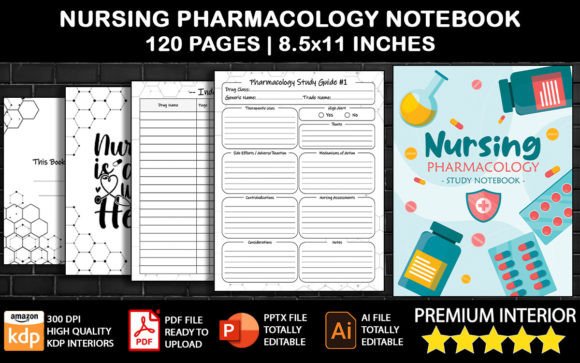
Imagine a page dedicated to "Metoprolol." Instead of freeform notes, the template might guide the student to systematically record: Drug Class (Beta-blocker), Mechanism of Action, Common Indications (hypertension, angina), Key Side Effects (bradycardia, hypotension), Important Contraindications, Specific Nursing Implications (monitor apical pulse, educate on dizziness), and typical Dosage Ranges. This structured approach ensures that no critical aspect is overlooked. It builds a habit of comprehensive thinking, mirroring the clinical decision-making process where all these factors must be considered before administration.
The Anatomy of an Effective Study Template
A well-designed notebook goes beyond individual drug pages. Its physical and organizational characteristics directly influence its effectiveness. A trim size of 8.5x11 inches offers ample space for detailed entries without being cumbersome. The inclusion of over 120 pages anticipates the vast number of medications covered in a standard program. High-quality resolution for both interior and cover speaks to durability, a necessary trait for a book that will be heavily used and referenced over months of study and into early clinical practice.
The most pivotal feature, however, is often the indexing system. Several dedicated index pages allow the student to record each drug's name and corresponding page number. As the notebook fills with dozens or hundreds of entries, this index becomes a personal, tailored reference guide. Searching for information on "Furosemide" no longer requires flipping through pages or consulting a digital search bar; a glance at the index provides the exact location. This manual curation process also reinforces learning, as the act of logging the drug in the index is another point of engagement with the material.
The Practical Workflow: From Classroom to Clinicals
How does such a notebook integrate into a student's actual workflow? Its use typically begins in the lecture hall or during independent textbook study. As a new drug class is introduced, the student creates a new entry in their Pharmacology blank study template book. The act of transcribing and synthesizing information from the source material into the template’s categories forces active processing, which is far more effective for memory retention than passive reading.
The notebook then transitions to the skills lab or simulation center. Before practicing medication administration, the student can quickly review their own notes on the drug’s specific considerations. Finally, it bridges into clinical rotations. While students cannot rely solely on personal notes in a hospital setting and must follow official drug guides, their personalized notebook serves as an excellent pre-shift review tool. Scanning entries for medications commonly used on their assigned unit (e.g., cardiac medications for a cardiology ward) prepares them mentally for the day’s tasks, boosting confidence and preparedness.
Comparative Advantages Over Digital Methods
In an increasingly digital academic world, the value of a physical notebook might be questioned. However, it offers distinct advantages. Cognitive research often suggests that handwriting notes, as required in a physical template, can enhance learning and memory compared to typing. The tactile process is slower, encouraging more selective and synthesized note-taking. Furthermore, the notebook is immune to digital distractions—no notifications, no temptation to multitask. It is a dedicated, single-purpose learning environment.
From a practical reliability standpoint, it requires no batteries, software, or login. It is always accessible and instantly searchable via its manual index. For many learners, the spatial organization—knowing that information on antibiotics is in the early pages and cardiac drugs in the later section—creates a mental map that aids recall. Digital folders and files can achieve this, but the physical embodiment of knowledge in a single volume has a unique psychological weight and permanence.
Considerations for Creators and Educators
The existence of such specialized tools also highlights a niche in educational resources. For creators designing these materials, the provided file formats—PDF ready for upload, editable PPT, AI, and EPS files for the cover—are crucial. They allow for professional publishing while also offering flexibility for instructors or institutions who might wish to customize the template for their specific curriculum. An educator might adapt the template to emphasize the particular drug classifications or nursing implications most relevant to their program, using the editable files to create a tailored version for their students.
For the broader audience of professionals, including practicing nurses, such a notebook concept isn't limited to students. New nurses transitioning to a specialty area, like oncology or critical care, could use a similar templated system to build their knowledge of the highly specific pharmacotherapy used in those fields. The principle remains: structured, active note-taking coupled with easy indexing accelerates mastery of complex information.
The Real-World Relevance: Building a Lifelong Reference
A common observation among nursing students who use these systematic notebooks is that they often do not discard them after graduation. The completed notebook becomes a condensed, personalized pharmacology reference from their formative training. While they will depend on up-to-date, institutional drug resources in practice, their personal notebook holds the foundational knowledge they built themselves. Reviewing it can quickly refresh concepts learned years prior. In some cases, the indexing and organization methodology learned through using the notebook instills a habit that professionals carry forward, organizing continuing education notes or specialty information in a similar, systematic way.
The ultimate goal of any nursing pharmacology course is not just to pass an exam, but to cultivate a practitioner who can safely and knowledgeably manage medication therapy—a responsibility central to patient outcomes. A Nursing Pharmacology Study Notebook is more than a study aid; it is a tool for constructing that knowledge architecture deliberately and retrievably. It turns the overwhelming stream of drug information into a curated, personal library, where each entry is a building block for clinical competence and, ultimately, for patient safety.