The Essential Guide to Cattle Record Keeping: From Farm Management to KDP Success
For generations, successful cattle farming has relied on more than just good pasture and strong livestock. It has been built on meticulous observation and careful record keeping. Today, this foundational practice remains as critical as ever, blending timeless husbandry wisdom with modern organizational tools. Whether you're managing a small family herd or a larger commercial operation, a systematic approach to logging your cattle's life cycle is the unseen engine of profitability, animal health, and operational efficiency.
This comprehensive guide explores the world of cattle record keeping, detailing its immense practical value and introducing a powerful modern tool: the specialized Cattle Log Book. We'll examine how moving from scattered notes to a consolidated system transforms your farm management, and how this necessity has also created an opportunity for entrepreneurs in the low-content book publishing space on platforms like Amazon KDP.
Why Record Keeping is the Backbone of Cattle Farming
At its core, cattle record keeping is the practice of systematically documenting every significant event and metric related to your herd. It goes far beyond mere memory aid; it is the data center of your farm. Think of it not as an optional administrative task, but as a crucial management activity that directly impacts your bottom line and animal welfare.
Without clear records, a farm operates on guesswork. With them, it operates on knowledge. This knowledge enables informed decision-making, helping you identify which cows are your most productive breeders, which calves are tracking for optimal growth, where your medical expenses are concentrated, and which lines are most profitable. It turns the complex, living system of your herd into understandable, actionable information.
The Tangible Benefits of a Log Book System
- Financial Clarity & Profitability: By tracking expenses—from feed and vet costs to equipment—against sales income, you gain a clear picture of your operational profit margins. You can pinpoint unnecessary expenditures and optimize your investment in each animal.
- Enhanced Breeding Program: Successful breeding isn't random. Records on bull performance, cow conception dates, calving histories, and offspring vitality allow you to select the best pairings, improve genetics over time, and plan your calving season efficiently.
- Proactive Health Management: A detailed medical and vaccination log helps you adhere to schedules, prevent disease outbreaks, and maintain a history for each animal. This is vital for both routine care and diagnosing recurring issues.
- Legal & Certification Compliance: Many markets, export requirements, and quality assurance programs demand verifiable records of origin, health treatments, and movement. A proper log book provides this evidence seamlessly.
- Operational Peace of Mind: It replaces stress and uncertainty with organization. Knowing you have a reliable reference for every animal's history saves time, reduces errors, and provides a invaluable asset for potential farm valuation or sale.
Anatomy of a Modern Cattle Record Notebook
While a simple notebook can suffice, a dedicated Cattle Record Notebook or Organizer is designed to cover every aspect of herd management in a logical, easy-to-use format. Such a book is typically structured into specialized sections, each serving a distinct purpose. Let's explore the key components you would find in a comprehensive template.
Core Sections and Their Practical Uses
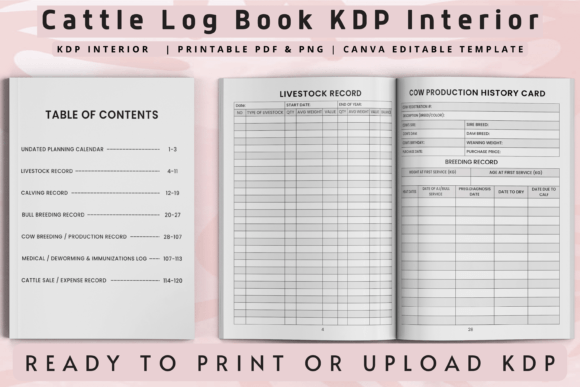
Undated Planning Calendar: This provides a flexible year-round framework for scheduling major activities like herd rotations, breeding windows, scheduled vaccinations, and market dates without being confined to a specific year.
Livestock Record: Often the starting point, this is a master list of all animals, including unique identifiers (like tags or names), birth dates, purchase dates, breed, and sex. It's your herd's roster.
Calving Record: A critical section for tracking individual births. Entries typically include the dam's ID, calving date, ease of birth, calf ID, sex, birth weight, and any complications. This data is essential for evaluating cow productivity and calf viability.
Bull Breeding Record & Cow Breeding Production Record: These complementary logs track mating activity. The bull record notes which cows were serviced and dates. The cow record details conception dates, expected calving dates, past reproductive history, and outcomes. Together, they form the blueprint of your herd's future.
Medical Log and Deworming/Immunizations: Health is wealth. These pages record every treatment, vaccine administered, illness observed, and veterinary visit. Maintaining this history ensures proper follow-up, identifies patterns of illness, and proves care standards.
Cattle Sales Record: This is your profit ledger. It documents each animal sold, the date, sale price, destination, and buyer information. It is the direct link between your management efforts and financial return.
Expense Records: To understand true profitability, you must track costs. This section categorizes and logs expenditures on feed, health supplies, labor, equipment maintenance, and other overheads.
From Farm Tool to Publishing Opportunity: The KDP Interior
The clear necessity for such organized record-keeping systems has spawned a valuable product category: pre-designed Cattle Log Book interiors. These are fully formatted, print-ready templates that farmers can purchase as physical notebooks or that entrepreneurs can publish themselves. This is where Amazon's Kindle Direct Publishing (KDP) platform becomes highly relevant.
KDP allows individuals to publish low-content and no-content books—like log books, planners, and journals—directly to Amazon's global marketplace. A Cattle Log Book KDP Interior refers to the complete, ready-to-use file package designed specifically for this purpose.
What a Ready-to-Upload KDP Package Includes
A professional KDP template package for a cattle record book is more than just a PDF. It is a suite of files designed for flexibility and success:
- Ready-to-Upload PDF (8.5 x 11 inches, No Bleed): The main print file formatted exactly to KDP's requirements for a standard interior. The "no bleed" specification means graphics and borders are set safely within the margins, ensuring perfect printing.
- Canva Editable File: Allows purchasers with Canva accounts to customize certain elements (like cover text or colors) before publishing, adding personalization.
- PNG File: Often includes high-quality graphic elements or a preview of the cover for marketing purposes.
- Complete 122-Page Interior: This encompasses all the sections described earlier—from the planning calendar through expense records—providing a thorough solution for the farmer and a complete product for the publisher.
Such a template is marketed as fully tested, meaning it has been validated to meet KDP's technical specifications, ensuring it won't be rejected during Amazon's review process. It is ready to list, allowing the publisher to focus on marketing and sales rather than complex design and formatting.
Addressing Common Misunderstandings
Two key assumptions often need clarification for those new to this topic.
First, some might think record keeping is only for large farms. In reality, small herd owners benefit even more proportionally, as every animal's performance is crucial to their limited operation's success. A single cow's poor breeding record or unexplained health cost can significantly impact a small farm.
Second, regarding KDP, there's a misconception that publishing such interiors requires deep design expertise. The availability of pre-made, tested templates fundamentally changes this. Entrepreneurs can enter the market by leveraging these ready-made products, focusing instead on understanding their agricultural audience and effective marketing. The template provides the product; the publisher provides the business acumen.
Integrating Record Keeping into Modern Agricultural Life
Today's cattle record keeping sits at a fascinating intersection. It respects the hands-on, empirical knowledge of the farmer while adopting the structured, data-driven approach of modern business management. It transforms anecdotal experience into analyzable data.
For the farmer, using a dedicated log book integrates this critical task seamlessly into daily life. Instead of juggling multiple notebooks or loose papers, one consolidated binder or journal becomes the go-to resource. It saves time during busy seasons, provides clarity during vet consultations, and offers a profound sense of control and legacy.
For the KDP publisher, it represents a clear opportunity to serve a specialized, professional niche. By providing a well-designed tool that solves a real and persistent problem, they build a business based on genuine utility. It aligns perfectly with Amazon's ecosystem, where practical, physical products for niche hobbies and professions thrive.
Building a Broader Understanding
Ultimately, cattle record keeping is a microcosm of effective management in any field. It emphasizes the principle that what is measured can be improved. Whether applied to livestock, a small business, or personal projects, systematic logging provides insight, control, and a path to optimization.
The Cattle Record Notebook, therefore, is more than just a book of pages. It is a framework for success. For the agriculturalist, it is a partner in stewardship and profitability. For the entrepreneur, it is a validated product meeting a defined market need. In both cases, it underscores a universal truth: good records make for good outcomes.
By embracing a comprehensive system—whether you purchase one or publish one—you are investing in a methodology that has supported farmers for centuries and now supports modern business creators. It connects the pastoral rhythm of the farm to the digital marketplace of today, proving that even the most traditional practices can find new life and new utility in our contemporary world.