The Foreman Daily Log Book: Your Single Point of Site Control
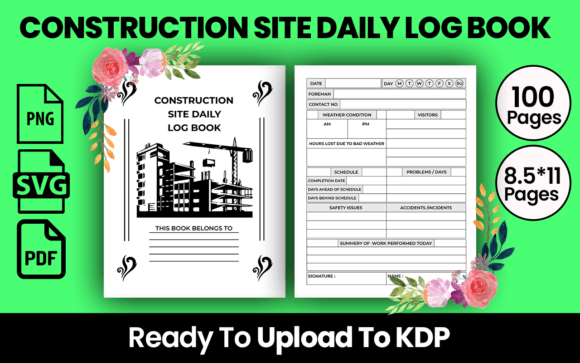
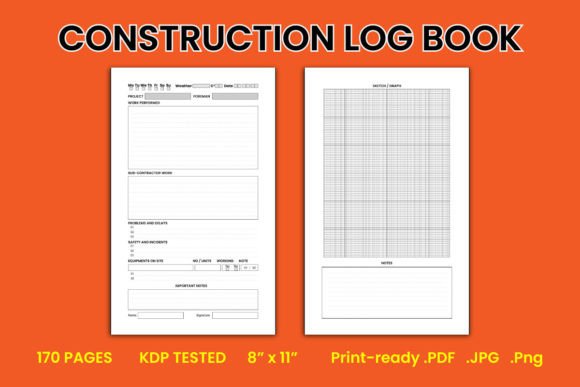
On a construction site, chaos is always just one miscommunication away. The Foreman Daily Log Book is a straightforward, purpose-built tool designed to be that critical anchor point of information. It’s not a generic notebook; it’s a structured daily log sheet with dedicated, spacious sections for all the essential job info a site supervisor needs to capture, track, and communicate. At 8.5 x 11 inches, it’s large enough to be comprehensive yet portable enough to be carried right where the work is happening.
Why a Dedicated Log Book Isn’t Just Paperwork
Many foremen and superintendents start their day with the intention of keeping notes—a scrap of paper, a digital app, a notebook. But by mid-morning, when the delivery arrives early, a subcontractor has a question about yesterday’s work, and the client calls for an update, that system often breaks down. Information gets fragmented. The Foreman Daily Log Book consolidates all that critical data into one authoritative place. Think of it as the official daily record of the site, replacing a dozen random sticky notes and text messages with one cohesive document.
This matters because in construction, what’s recorded is what’s accountable. Using a consistent log book means every day’s report has the same structure: job information, crew present, work completed, materials delivered, safety observations, equipment usage, and incidents. This consistency isn’t for bureaucracy; it’s for clarity. When a project manager reviews the week’s logs, they can instantly compare progress. When there’s a question about a delivery date, the foreman can turn to a specific dated page instead of searching a memory or a scattered email chain.
Real-World Applications: From the Trenches to the Office
The use cases for this log book stretch across the entire build cycle. For a general contractor managing multiple sites, it provides a standardized report format from every foreman, making remote oversight efficient and reliable. They’re not interpreting different note-taking styles; they’re reading clear, categorized data.
For the site foreman or superintendent, it’s their daily command center. It helps them start the day by planning crew assignments, track progress against the schedule in real-time, and formally note any delays or issues—creating an indisputable record for future discussions about timelines or change orders. At the end of the day, it’s their tool for compiling a concise report to send up the chain.
Project managers benefit during client meetings and audits. Having a complete set of daily logs transforms vague updates into precise, date-stamped evidence of work completed, challenges encountered, and resources used. It builds trust through transparency.
Turning Daily Entries into Tangible Project Benefits
Let’s look at how this transitions from simple entries to real outcomes. Imagine a scenario where a critical concrete pour is scheduled for Thursday. On Wednesday, the foreman using the Foreman Daily Log Book notes, “All forming completed, rebar inspection passed, pump truck confirmed for 7 AM.” Thursday morning, the pump truck breaks down. The foreman immediately logs the incident, the time, and the action taken: “Called alternate supplier, new arrival estimated 10 AM.” This isn’t just a note; it’s the first document in a potential delay claim. It’s objective, immediate, and professional.
Or consider safety. A daily section for safety observations encourages the habit of actively looking for hazards. Logging “Trip hazard identified near east stairwell, marked and crew informed” reinforces a culture of proactive safety. Over time, the collection of these daily logs becomes a powerful tool for safety training and compliance reviews, showing a pattern of vigilant site management.
The large Job Info sections on each sheet ensure that vital project identifiers—job name, number, location, key contacts—are always right on the page. This prevents simple but costly errors, like a daily report being filed under the wrong project, which can happen easily with loose notes.
Who Else Finds Value in a Foreman’s Tool?
While designed for construction, the principles of the Foreman Daily Log Book apply to any complex, multi-person, day-to-day operation. Facility managers running major renovations or maintenance cycles can use it to track contractor work, vendor deliveries, and internal crew tasks. Event production managers setting up a large festival or conference could adapt it to log stage build progress, vendor arrivals, and permit inspections. Even in manufacturing or warehouse logistics, a supervisor overseeing a significant installation or reorganization might find its structured daily format invaluable for maintaining control and documentation.
The key is any situation where daily progress, resource allocation, and incident tracking need to be clear, consistent, and easily retrievable. The physical book format offers an advantage in many of these hands-on environments: it’s always on, doesn’t need Wi-Fi, can be quickly passed around for a subcontractor to sign off on their work section, and exists as a permanent, unalterable record once the page is filled.
Choosing the Right Tool for Your Site’s Rhythm
Before deciding if a Foreman Daily Log Book is right for your operation, consider the flow of information on your site. Do daily updates get lost between texts, calls, and hastily written emails? Is there friction when higher management asks for details about last week’s progress? Do you find yourself recreating the story of the day at the end of a long shift because your notes were incomplete?
This log book works best for teams that recognize documentation as a part of the job, not a distraction from it. It requires the discipline to use it consistently. The payoff is a reduction in “information hunting,” fewer misunderstandings, and a robust historical record that can protect the company and the client.
Consider also the scale. For a small, short-term project, a simple notebook might suffice. But for any project of significant duration, complexity, or with multiple stakeholders, the structured format pays dividends. The large page size provides ample room for detailed entries without feeling cramped, which encourages more complete reporting.
Ultimately, the Foreman Daily Log Book is more than a product. It’s a system for creating order. It takes the universal foreman’s challenge—managing the relentless stream of people, materials, tasks, and problems—and provides a simple, physical framework to capture it all. By centralizing the day’s critical data, it turns daily reporting from a reactive chore into a proactive tool for control, communication, and accountability. For anyone responsible for the momentum of a job site, it becomes not just a record of what happened, but a foundational part of making things happen as planned.